|
Mista Ballista uses hydraulics for lifting the engine to a 45 degree angle for firing, and also for winding the cord bundles.
We also like having electricity on hand since Mr. B has a tendency to break, and need on-field repairs. This page describes
what we are using to power up the system.
 We acquired this generator on Ebay. It was originally someone's home backup unit, which they never used.
It generates around 5800 watts.
We acquired this generator on Ebay. It was originally someone's home backup unit, which they never used.
It generates around 5800 watts.
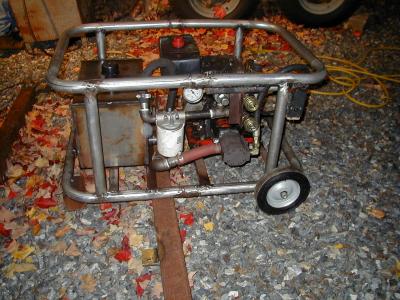 Our hydraulic power unit was designed and built by Jeff. The engine is off an old snowblower, and has a handy electric start.
The pump and other hydraulic parts were bought new, designed for a log splitter. The Punkin Chunkin association requires that hydraulic hoses and parts are "like new", and not of junked tools, so this was important.
Our hydraulic power unit was designed and built by Jeff. The engine is off an old snowblower, and has a handy electric start.
The pump and other hydraulic parts were bought new, designed for a log splitter. The Punkin Chunkin association requires that hydraulic hoses and parts are "like new", and not of junked tools, so this was important.
The frame is welded up bits of exhaust tubing.
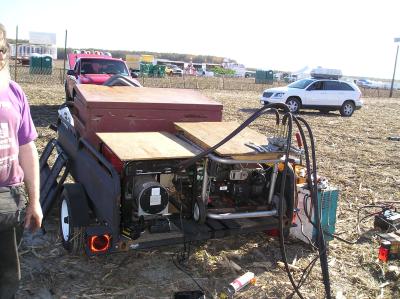 In 2005, we started using an auxiliary trailer to haul our power units onto the field. This saved lots of grunting and lifting of these heavy items as we could just leave them on the trailer. It also helps keep our pit tidy.
|
The 2007 all-in-one Power Pak
|
 In 2006, we purchased a 35 Hp diesel engine off a refrigeration truck. Sadly, the guys selling it thought they'd do us a favor by just cutting all the hoses and electric bits to extract the motor thinking we were going to part it out. So we had to piece quite a bit of it back together. Oh well.
 We acquired an old welder/generator unit with a defunct gasoline engine.
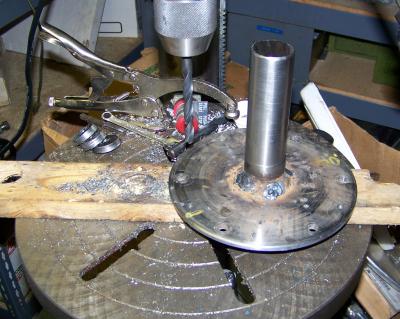
We measured up the flywheel interface on the diesel engine, and Jeff fabricated an adapter shaft so we could attach our welding head to it.
We acquired an old welder/generator unit with a defunct gasoline engine.
We measured up the flywheel interface on the diesel engine, and Jeff fabricated an adapter shaft so we could attach our welding head to it.
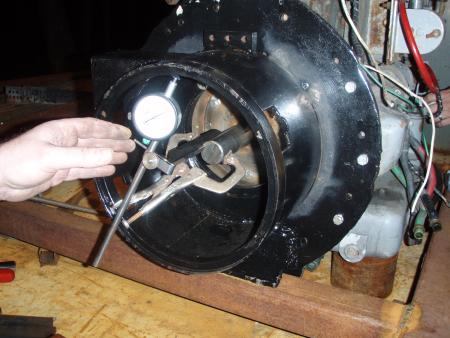 Once the adapter shaft was bolted onto the flywheel, the bell housing for the welder/generator head was fitted to an adapter plate, and then to the
housing around the flywheel. To weld the generator housing onto the new adapter plate, we spent a bunch of time measuring the
wobble to make sure everything was perfectly centered.
Once the adapter shaft was bolted onto the flywheel, the bell housing for the welder/generator head was fitted to an adapter plate, and then to the
housing around the flywheel. To weld the generator housing onto the new adapter plate, we spent a bunch of time measuring the
wobble to make sure everything was perfectly centered.
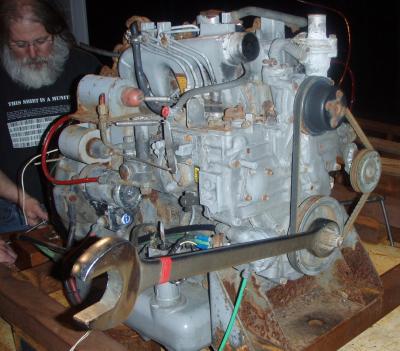 A really big wrench was used to spin the main shaft on the engine so that we could do the indicator measurements on the other side.
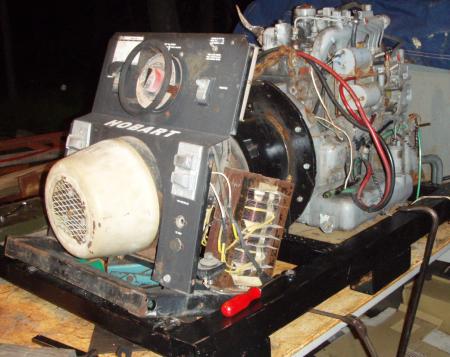 Once that was welded together, we were able to mount the welder/generator head onto the engine. There were lots of random dangling bits of wire and
do-dads that enables the welder and provides AC power. Quite a bit of time is being spent building mounting brackets so all this stuff
can be bolted down to something.
Once that was welded together, we were able to mount the welder/generator head onto the engine. There were lots of random dangling bits of wire and
do-dads that enables the welder and provides AC power. Quite a bit of time is being spent building mounting brackets so all this stuff
can be bolted down to something.
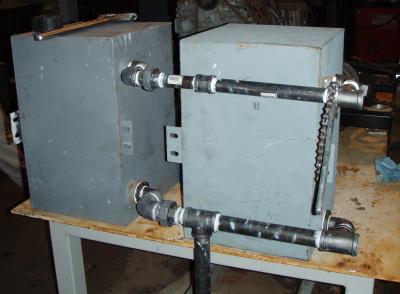 We bought two 19 gallon hydraulic tanks because they were on sale, cheaper than one 25 gallon tank, and fit into the footprint of
the powerpak nicely. Sadly, we then had to plumb together a new monstrosity.
We bought two 19 gallon hydraulic tanks because they were on sale, cheaper than one 25 gallon tank, and fit into the footprint of
the powerpak nicely. Sadly, we then had to plumb together a new monstrosity.
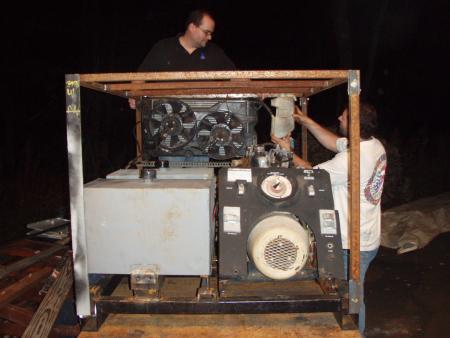 Once the tanks were mounted, the upper frame was built. The top of this frame is removable so we can get inside.
In this picture, Kevin and Dave are laying out the location of where the radiator will hang.
Once the tanks were mounted, the upper frame was built. The top of this frame is removable so we can get inside.
In this picture, Kevin and Dave are laying out the location of where the radiator will hang.
|
Additional Pages for Mista Ballista
|
|
Mista Ballista
|
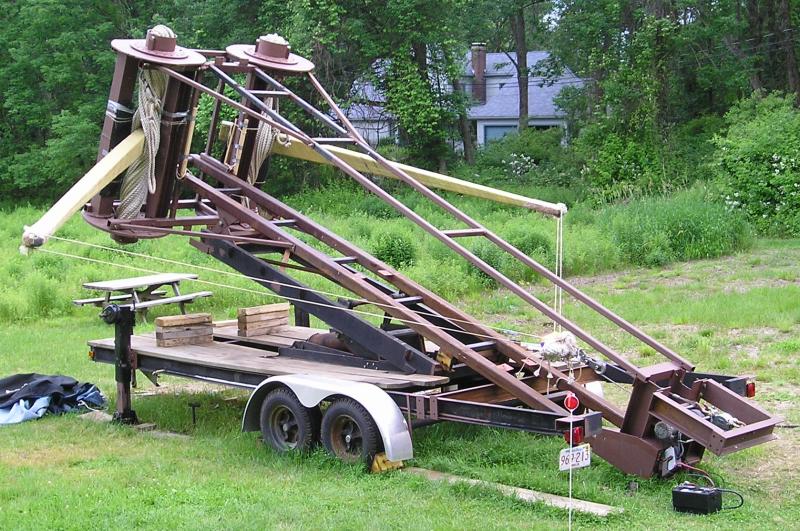 Mista Ballista is _Team Tormentum's_ *Torsion Division* competition catapult.
|
|
Mista Ballista : Modiolus and Epizygis
|
 In 2008, Dave devised a new system for managing the torsion in Mista Ballista with his friends Karl Hamm and Kevin Cheney.
This represents a large investment in our machine in these custom parts.
In 2008, Dave devised a new system for managing the torsion in Mista Ballista with his friends Karl Hamm and Kevin Cheney.
This represents a large investment in our machine in these custom parts.
|
|
Mista Ballista : Bowstring
|
 The bowstring has been one of the most challenging pieces of our torsion engine. It is the last piece to get right, and has been the most likely part to fail in any given year.
|
|
Mista Ballista : Rope Bundles
|
 The rope bundles are the main engine of the machine. The framework that holds
everything together is about 24 ft long, and 6 feet tall.
The rope bundles are the main engine of the machine. The framework that holds
everything together is about 24 ft long, and 6 feet tall.
|
|
Mista Ballista : 2005 Rope bundle Upgrade
|
 At the 2004 chunk the main stanchions for the torsion frames were bent by the impact of the arms.
You can see the animation of when this happened on the Mista Ballista Arms page.
At the 2004 chunk the main stanchions for the torsion frames were bent by the impact of the arms.
You can see the animation of when this happened on the Mista Ballista Arms page.
|
|
Mista Ballista : 2006 Rope Bundle Reconfiguration
|
 In 2005 we broke our fancy fiberglass arms. In 2006 we got the new carbon fiber arms
and video taped them in action in the summer at our 2006 History Chunk. This led us to discover how much they bounced around
the outer stanchions. We were getting multiple recoils after every shot, sometimes back at least 30 degrees. That was also just with 2000 lbs of pullback, which is much less than we expect to use in competition.
In 2005 we broke our fancy fiberglass arms. In 2006 we got the new carbon fiber arms
and video taped them in action in the summer at our 2006 History Chunk. This led us to discover how much they bounced around
the outer stanchions. We were getting multiple recoils after every shot, sometimes back at least 30 degrees. That was also just with 2000 lbs of pullback, which is much less than we expect to use in competition.
|
|
Mista Ballista : Frame
|
 The framework for the Ballista had to be built strong enough to resist the pullback, and to hold up
the 2500 pounds we currently estimate of our engine. It must also push it up 16 feet in the air!
The framework for the Ballista had to be built strong enough to resist the pullback, and to hold up
the 2500 pounds we currently estimate of our engine. It must also push it up 16 feet in the air!
|
|
Mista Ballista : Trailer
|
 One of our goals for the 2003 season is to acquire a dedicated trailer for Mista Ballista.
|
|
Mista Ballista : Torsion
|
 Mista Ballista's engine operates on torsion from twisted rope bundles. One of the biggest challenges
of torsion for this machine has been adding the twist. An onager is pretty straight forward in that a large lever and gravity can be used. With our ballista, the direction of twist is sideways, so an alternate means of twisting is needed.
Mista Ballista's engine operates on torsion from twisted rope bundles. One of the biggest challenges
of torsion for this machine has been adding the twist. An onager is pretty straight forward in that a large lever and gravity can be used. With our ballista, the direction of twist is sideways, so an alternate means of twisting is needed.
|
|
Mista Ballista : Arms
|
 After the failure of our arms in 2007, a new tactic was needed. Dave contacted his friends Karl Hamm and Kevin Cheney about designing
and building a set of ballista arms out of aluminum. Aluminum was chosen for its strength and light weight.
After the failure of our arms in 2007, a new tactic was needed. Dave contacted his friends Karl Hamm and Kevin Cheney about designing
and building a set of ballista arms out of aluminum. Aluminum was chosen for its strength and light weight.
|
|
Mista Ballista : Deployment
|
 To travel to different chunkin' locations, we need to pack the system down onto our trailer.
Deploying from the folded up position is challenging and time consuming, taking a day and a half
at the 2002 chunk. This year at the 2003 Punkin Chunk, we were done in about 4 hours.
To travel to different chunkin' locations, we need to pack the system down onto our trailer.
Deploying from the folded up position is challenging and time consuming, taking a day and a half
at the 2002 chunk. This year at the 2003 Punkin Chunk, we were done in about 4 hours.
|
|
Mista Ballista : Hydraulic and Electric Power
|
Mista Ballista uses hydraulics for lifting the engine to a 45 degree angle for firing, and also for winding the cord bundles.
We also like having electricity on hand since Mr. B has a tendency to break, and need on-field repairs. This page describes
what we are using to power up the system.
|
|
Mista Ballista : Mystery Parts
|
 All winter during 2003 we have been collecting the parts we need to accomplish our 2003 chunk goals.
Here are a bunch of pictures of these random parts. Can you guess what they are for?
All winter during 2003 we have been collecting the parts we need to accomplish our 2003 chunk goals.
Here are a bunch of pictures of these random parts. Can you guess what they are for?
|
|
Mista Ballista : Modiolus and Epizygis 2007
|
 This page describes the Modiolus and Epizygis system we used from 2002 through 2007. In 2008 we developed
a new system for twisting up Mista Ballista.
This page describes the Modiolus and Epizygis system we used from 2002 through 2007. In 2008 we developed
a new system for twisting up Mista Ballista.
|
|
Mista Ballista : Torsion 2007
|
 All torsion catapults depend on twisting the rope bundles to create the engine to drive the catapult. Mista Ballista went through
many phases as we attempted to add more power every year to our throw. This page describes the obsolete systems
we'd used in the past.
All torsion catapults depend on twisting the rope bundles to create the engine to drive the catapult. Mista Ballista went through
many phases as we attempted to add more power every year to our throw. This page describes the obsolete systems
we'd used in the past.
|
|
Mista Ballista : Arms 2006 - 2007
|
 This page describes the construction of our dearly departed Carbon Fiber composite arms. We miss them.
|
|
Mista Ballista : Failed Arms
|
 Building an arm for a torsion machine this large has proven to be very challenging.
Based on the experiences of our competitors, who also keep breaking arms, we find that
we are not alone in this dilemma.
Building an arm for a torsion machine this large has proven to be very challenging.
Based on the experiences of our competitors, who also keep breaking arms, we find that
we are not alone in this dilemma.
|
| 
