
How to Trigger a Siege Engine
|
|||||||||
|
Different types of machines store their energy in different ways. While we have been successful in adapting different styles of triggers between machines, the type of trigger you construct will depend on the load and structure of the machine. In particular, if you build small models first, it is nearly impossible to use similar construction techniques between the small and larger scale, though similar design is usually possible.
The design is quite simple. An L or T shaped bar is constructed. One bar rides over the arm (as in the case for our onagers) or through a loop on the bottom of the arm. The opposing bar goes down to a pivot beneath the arm. The forces applied to the trigger will attempt to straighten everything out. Your pivot must be rotating in a plane that is perpendicular to the force applied by the arm. Our small onager was not designed this way, but the materials in the trigger are much stronger than the torsion bundle.
In this image, if the trigger were tipped more to the left, it would launch itself. If the trigger were tipped more to the right, it would be nearly impossible to fire the machine. Often balancing this trigger is done after cranking the machine down. Inexperienced users have been known to set things up so that they can't get the trigger to pull over.
The hook mechanism was replaced with a barn door style hinge. The trigger still isn't in line, but I was hoping the hinge would be stronger. It did last well, but when we added a little more power, it too has become quite bent, though it is still functional.
When triggering a trebuchet such as Juggernaut 2, or other machine where the trigger is attached directly to an arm, it is necessary to balance the force of the lead-rope directly against the trigger tooth. If the arm has potential to wobble, it is important to add a guide or governor to make sure the line stays steady.
On Baby Treb some credit-cards are used to shim the hook. The hook has it's point in the side of the machine. When the cards are removed, then the pull on the chain forces the hook to pull. Shimmed hook triggers were common for spear shooting ballistas as well. These types of machines had a sliding trigger mount called a Chelonium. This provided the base for the hook to press against.
An inline trigger is a device used to release a line under load. Commonly used on sailboats, or other marine applications, they are also useful for triggering a catapult. A cheap way of doing an inline trigger is to use a sacrificial line, meaning that the arm is tied down, and the rope holding it is cut to launch the machine.
Commercial Inline triggers always have a load rating. You will need to know what your load is to safely use these small devices.
The big Sea Catch pictured here is used on our machine Mista Ballista and can handle over 7000 pounds. The small one will be used on a medium sized model and can handle over 700 pounds. We opted to go with a Sea Catch due to the high load rating (some models handle over 70 tons) and the recommendations of our peers. If you call to order one, be sure to let them know where you first read about them.
|
|
Contact: Team Tormentum Copyright © 2000-2022 Eric M. Ludlam All rights reserved. Twas' brillig, and the slithy toves did gyre and gimble in the wabe... | Last Modified: 12/18/21 |


 Hook triggers are the simplest to conceptualize and build, and the
hardest to get right. At a small scale (as with this trigger on
Hook triggers are the simplest to conceptualize and build, and the
hardest to get right. At a small scale (as with this trigger on
 When building this type of trigger on the larger scale,
the forces applied to the trigger are much greater. In this case
When building this type of trigger on the larger scale,
the forces applied to the trigger are much greater. In this case

 It is important to balance the trigger over the arm. The bar that
locks the arm down must be perpendicular to the desired motion of the
arm.
It is important to balance the trigger over the arm. The bar that
locks the arm down must be perpendicular to the desired motion of the
arm.

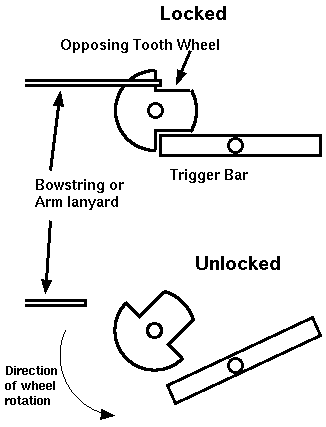
 An Opposing Tooth gear is easily made starting with a single
circular piece of wood or metal. Two notches are then removed with
the faces 180 degrees across from each other. One tooth will hold
back the stored energy of the machine. The other will be blocked by
a trigger pawl.
An Opposing Tooth gear is easily made starting with a single
circular piece of wood or metal. Two notches are then removed with
the faces 180 degrees across from each other. One tooth will hold
back the stored energy of the machine. The other will be blocked by
a trigger pawl.


 A Shimmed Hook Trigger holds a line or rope between a solid piece
of the machine frame, and a hook. The hook pivots on one end, but is
prevented from releasing the line by a shim or block. When the block
is removed, the hook pivots, releasing the triggering line.
A Shimmed Hook Trigger holds a line or rope between a solid piece
of the machine frame, and a hook. The hook pivots on one end, but is
prevented from releasing the line by a shim or block. When the block
is removed, the hook pivots, releasing the triggering line.

 Despite the fact that I get money if you buy one of the triggers in the previous section,
my team are big fans of the
Despite the fact that I get money if you buy one of the triggers in the previous section,
my team are big fans of the