|
Torsion bundles are basically large amounts of twisted rope.
These provide the motive force behind Onagers, Ballistas. Most of
our torsion machines are still quite small. The materials you use
will dictate the size of machine you can build.
It is important to remember that when building the frame for your
torsion machine that the force imparted at the end of your arm is
quite small compared to the crushing force imparted on your frame.
On our machine Onager Jr,
for example, the arm only generates about 200lbs of force at the
throwing end, but the inward pull of the rope bundle exceeded 1500lbs
of force. (The amount needed to permanently deform the rope we were
using.)
 Much of this terminology is greek, and we found it first at the
Knights Armoury, but we also found this terminology in
a book on siege engines by Eric Marsden.
Much of this terminology is greek, and we found it first at the
Knights Armoury, but we also found this terminology in
a book on siege engines by Eric Marsden.
- Modiolus
- This roughly translates to `washer', and it
holds the Epizygis in place, and bears against the hole carrier beam.
- Epizygis
- This roughly translates to `lever'. It is an
iron bar that the rope is wrapped over. It's width should be about
1.5 times the diameter of the rope you are using.
- Rope sleeve
- Historically there were no rope sleeves, but
we decided to add one to protect our rope which is the most expensive
part of our machine.
- Skein
- This is the rope that is wrapped into the spring
which forms the engine of a torsion machine.
- Scutula
- This roughly translates to `hole carrier'. A
term used for the load bearing beams in the machine's frame that
carries a hole through which the rope is run.
 Torsion bundles depend on the stretchiness of the rope you use.
A Hemp style rope, or a static climbing rope, would not be very good
for use in a skein. If you tighten up the rope bundles with the machine at rest, it will take a huge amount of force to cock the machine. The difference in force from fully cocked to
at rest is significant. This means your projectile gets a jolt at the start,
then quickly overtakes the arm which is not being pushed as hard as it
rotates. This reduces the effective acceleration curve of your machine and reduces your throwing distance. It also requires that you use reasonably solid projectiles.
Torsion bundles depend on the stretchiness of the rope you use.
A Hemp style rope, or a static climbing rope, would not be very good
for use in a skein. If you tighten up the rope bundles with the machine at rest, it will take a huge amount of force to cock the machine. The difference in force from fully cocked to
at rest is significant. This means your projectile gets a jolt at the start,
then quickly overtakes the arm which is not being pushed as hard as it
rotates. This reduces the effective acceleration curve of your machine and reduces your throwing distance. It also requires that you use reasonably solid projectiles.
A stretchy rope like nylon, polyester, or even polypropylene keeps the
force imparted at the arm closer to constant between cocked and at rest. This is because the stored force when the machine is fully cocked is not too much greater than when the machine is at rest. As a result you can add a lot of preload to the arm, and get a more consistent acceleration curve.
It is a good idea to keep the thickness of your epizygis between 1.5 - 2 times the
diameter of the strands of the rope in your skein. Anything smaller can
cause the epizygis to act more like a knife than you may like. In the
picture our epizygis is too narrow.

It is better to have many small strands, than just a few very
large strands. The result is a more even load spread across the bundle.
The different strands must be wound at equal tension as well.
While some settling will occur evening things out, too much difference can
result in a rope breaking as it takes a greater load than the others.
The rope will fail critically in this case. Surprisingly, such disaster can go unnoticed beyond a sudden drop of performance.
These skeins are 1 inch in diameter.
 For very small machines, such as Baby Onager or
Baby Ballista, simple materials can
be used to build the modiolus and epizygis. Large machines require
that after the skein is tightened that the modiolus be pinned to the
hole carrier to prevent it from unwinding.
For very small machines, such as Baby Onager or
Baby Ballista, simple materials can
be used to build the modiolus and epizygis. Large machines require
that after the skein is tightened that the modiolus be pinned to the
hole carrier to prevent it from unwinding.
Machines of this size can have a large bearing surface between the
modiolus and hole carrier because it is easy to overcome the friction
when hand while tightening. Once wound, friction will keep it from
unwinding.
 While wood on wood provides good friction, adding this thin metal
plate under the modiolus reduces friction. This make it easier to
wind it up more. To tighten it beyond what the friction in this case
can withstand, a nail can be added to pin it down.
While wood on wood provides good friction, adding this thin metal
plate under the modiolus reduces friction. This make it easier to
wind it up more. To tighten it beyond what the friction in this case
can withstand, a nail can be added to pin it down.
 In my third torsion model, I augmented the wooden modiolus with a metal
plate of the same circumference. The metal prevented fatigue in the plywood
where the epizygis digs in. I welded the epizygis onto the metal disk,
preventing slippage. The wood-on-wood friction also prevents the need for
pins. The extra long epizygis allows a pipe to be fitted over the rod
for easy tightening.
In my third torsion model, I augmented the wooden modiolus with a metal
plate of the same circumference. The metal prevented fatigue in the plywood
where the epizygis digs in. I welded the epizygis onto the metal disk,
preventing slippage. The wood-on-wood friction also prevents the need for
pins. The extra long epizygis allows a pipe to be fitted over the rod
for easy tightening.
 Medium sized skeins (here at three inches) are similar to those
for the smaller machines. A wide base to the modiolus means lots of
friction against the hole carrier. This image is from
Ballista Jr.
Medium sized skeins (here at three inches) are similar to those
for the smaller machines. A wide base to the modiolus means lots of
friction against the hole carrier. This image is from
Ballista Jr.
For our first machine, we built 3 different setups before we
settled on this one. All our other machines used very small epizygis
which just bent in. Eventually Greg built this setup for us (See
very first image on this page for all the pieces.)
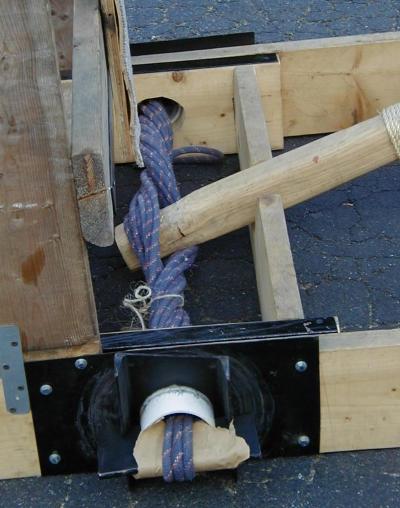
The Modiolus is a piece of 6 inch channel that has been cut roughly
square. A hole large enough for our rope sleeve (made from a PVC pipe
coupler) was put in the center. Lastly, two cuts in the flanges of
the channel were made so that the epizygis would fit. The epizygis
is 1/4 inch steel from an I beam Eric found near a bridge
construction. To cut down on some of the friction, the washer on our
hole carrier were two thin strips of metal bolted to the frame.
We then wrapped the machine using Polypropolene rope.
Unfortunately, the modiolus would bend over the washer plates on
the hole carrier. Eventually, this machine imploded when our hole
carriers were crushed.
 After Ballista Jr died in battle Eric built
Onager Jr and recycled the setup from
the ballista. This time the narrow washer plates were ejected, and a
full sized metal plate was bolted onto the side of the onager. Much
larger beams were used for the hole carriers as well, which has kept
the machine alive.
After Ballista Jr died in battle Eric built
Onager Jr and recycled the setup from
the ballista. This time the narrow washer plates were ejected, and a
full sized metal plate was bolted onto the side of the onager. Much
larger beams were used for the hole carriers as well, which has kept
the machine alive.
This setup has vast amounts of friction between the modiolus and
the hole carrier washer plate. Eric made the mistake of painting the
washer plate (though not the bottom of the modiolus.) This makes it
very difficult to tighten the skein. A side effect, however, is that
it has never unwound itself because the skein cannot generate that
much force either.

This modiolus has 11 inches inside for rope, and a two foot
flange. Our epizygii is 1 1/2 inches thick and 5 inches tall.
The theoretical maximum inward crushing force we've predicted so far,
based on maximum working load before failure on the rope we'd like to
use, is 105 tons. Cool!
In this picture, we had just started winding the rope. You can see our
hole circle in the modiolus with 20 1 inch holes. There are 6 holes in
the scutula, two sets of three. The combination of angles we chose gives
us a tiny 6 degrees of resolution when winding our bundles. Unlike the
medium sized modiolus on Onager Jr, this large bundle has to be pinned in
place, or it will unwind itself.

We first used a come-along, but found it too weak. We then
moved to hydraulics, but now find that doing so requires a lot more thought.
You can read more about our torsion mechanism on the
Mista Ballista Torsion Page.
We eventually created Torsioning Arms
for Mista Ballista. This makes it much safer to tighten the bundle
and works very well, if slowly.
 Torsion machines need to be wound tight, or they aren't very
useful. For Onager Jr, we found that if we tipped it up on end, we
had more room to use our wrench. Ancient wrenches were apparently
custom made iron tools with special fittings on the end. We used a
two by four, and scrap of rope. In this picture, Roger is sitting on
the machine so that these students can put their weight into our four
foot wrench. The Epizygis sticks out a ways on each side, so we wrap
the rope around the errant end of the epizygis, and then lean into
the modiolus. This works quite reliably for Onager Jr.
Torsion machines need to be wound tight, or they aren't very
useful. For Onager Jr, we found that if we tipped it up on end, we
had more room to use our wrench. Ancient wrenches were apparently
custom made iron tools with special fittings on the end. We used a
two by four, and scrap of rope. In this picture, Roger is sitting on
the machine so that these students can put their weight into our four
foot wrench. The Epizygis sticks out a ways on each side, so we wrap
the rope around the errant end of the epizygis, and then lean into
the modiolus. This works quite reliably for Onager Jr.
 Arms for torsion machines suffer much more stress than those of
trebuchets. In particular, the fast stop necessitated by the breaker
beam can be very hard on an arm. They need to be beefier, yet nicely
tapered to the end to help with acceleration.
Arms for torsion machines suffer much more stress than those of
trebuchets. In particular, the fast stop necessitated by the breaker
beam can be very hard on an arm. They need to be beefier, yet nicely
tapered to the end to help with acceleration.
To help keep the arm alive longer,
Onager Jr has a long breaker beam nearly
the same length as the arm itself. The beam in this image was
destroyed very quickly, and was replaced with plywood and part of an
old street sign. We read about this technique in
The Book of the Crossbow, and
WEAPONS: An International Encyclopedia from 5000 B.C to 2000 A.D.
A second technique is to wrap the arm in some sort
of rope. This lashing technique is similar to that used for wooden
sailboats, for masts and booms, and also for quickly repairing tools
such as shovels and axes.
The wrapping job in this images was replaced when Eric re-wrapped
using the
"Rip-wrap".
 When attempting to use metal arms, care must be taken. We tried using
3 inch structural box for arms on Mista Ballista, and after relatively low
power twisting, it still completely folded the metal box.
When attempting to use metal arms, care must be taken. We tried using
3 inch structural box for arms on Mista Ballista, and after relatively low
power twisting, it still completely folded the metal box.
To learn more about how not to make Ballista Arms you can read about
it in the Mista Ballista pages. Our newest arms are hopefully the
way it should be done and will last us a long time.
You do need to be careful since arm failure can be sudden and dangerous.
|
Frames holding torsion bundles
|
 Holding back that much force requires a beefy frame. Onager Jr's frame was made from 2x10s
doubled up around the hole carrier. Tenons and mortises should be used in wooded frames
like this one with no nails, screws or glue. Adding a nail or screw in these situations will
create a point load inside the frame, and at the massive loads you will put on your frame,
it will likely cause a critical failure.
Holding back that much force requires a beefy frame. Onager Jr's frame was made from 2x10s
doubled up around the hole carrier. Tenons and mortises should be used in wooded frames
like this one with no nails, screws or glue. Adding a nail or screw in these situations will
create a point load inside the frame, and at the massive loads you will put on your frame,
it will likely cause a critical failure.
 Better than the tenons that pass all the way through the mortise as with the Onager Jr picture
above are hidden mortises. Basically, don't cut a hole all the way through the carrying beam,
and cut the tenons only as long as the holes are deep. This will leave more material in
the carrying beam (more strength) while having the same jointing effect.
Better than the tenons that pass all the way through the mortise as with the Onager Jr picture
above are hidden mortises. Basically, don't cut a hole all the way through the carrying beam,
and cut the tenons only as long as the holes are deep. This will leave more material in
the carrying beam (more strength) while having the same jointing effect.
This picture is from my model Hatra Ballista.
 The frame that holds a torsion bundle must withstand crazy forces. For example,
Onager Jr's frame holds a 3" rope bundle, though I haven't put much more that 2" in
it so far. With Poly Propolyne rope, I generated about 200lbs of force at the tip of our 3 foot arm.
Inside the bundle, however, the frame held back over 1500lbs of force, which is what
the manufacturer claimed was the working load of our bundle (300lbs per strand.)
The frame that holds a torsion bundle must withstand crazy forces. For example,
Onager Jr's frame holds a 3" rope bundle, though I haven't put much more that 2" in
it so far. With Poly Propolyne rope, I generated about 200lbs of force at the tip of our 3 foot arm.
Inside the bundle, however, the frame held back over 1500lbs of force, which is what
the manufacturer claimed was the working load of our bundle (300lbs per strand.)
To handle this load, I eventually added angle-iron from an old bedframe between the layers
of pine. This kept the pine flat while torsioning the machine under these loads.
 For Mista Ballista, we have generated almost 1400lbs of force on the tips of our 10 foot arms
before they broke which pushed our polypropolyne rope past it permanent deformation strength.
With about 64 wraps of 3/4" poly-P going past the safe working load 2000lbs, that
adds up to about 128,000lbs of force resisted.
For Mista Ballista, we have generated almost 1400lbs of force on the tips of our 10 foot arms
before they broke which pushed our polypropolyne rope past it permanent deformation strength.
With about 64 wraps of 3/4" poly-P going past the safe working load 2000lbs, that
adds up to about 128,000lbs of force resisted.
A side effect is that the arms bent our wimpy 6" channel stanchions, and we needed to weld on
lots of strengtheners.
| 
